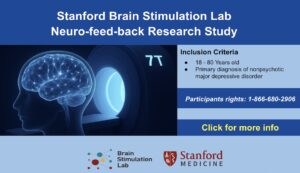
 Stanford University’s Brain Stimulation Lab, exploring the effects of neurofeedback training.This study aims to evaluate the efficacy and safety of advanced neurofeedback techniques using a high-resolution 7T MRI scanner. This feasibility study will inform the design of a subsequent clinical trial targeting major depression.
The Protocol Director for this study is David Spiegel, MD, Psychiatry and Behavioral Sciences.
The study is designed as an 8-arm feasibility trial conducted on a 7TMRI Scanner. 30 Participants will be randomized equally into 8-arms totaling 240 participants.
Screening Process:
Patients will be asked to complete a pre-screening survey that will ask them questions on their medical and psychiatric history. Once reviewed and deemed eligible to proceed to our formal screening process virtual assessments will be conducted via zoom with our study team and clinical psychologists.
Study Timeline/Visits:
Inclusion Criteria:
-
- Male or Female, between the ages of 18 and 80 at the time of screening.
- Primary diagnosis of nonpsychotic major depressive disorder (MDD) without a history of psychotic features.
- Score on the MADRS scale between 15-25
- Able to read, understand, and provide written, dated informed consent prior to screening. Proficiency in English sufficient to complete questionnaires / follow instructions during fMRI. Stated willingness to comply with all study procedures, including availability for the duration of the study, and to communicate with study personnel about adverse events and other clinically important information.
- Must possess an iPhone with the latest iOS version compatible with the app, and be capable of using the study app with the phone.
- 1-5 lifetime adequate antidepressant medication failures during their current episode (ATHF).
- The dose of the primary antidepressant medication (if applicable) must be stable for 4 weeks prior to baseline, and participants must agree to continue at this dose throughout the study period.
- In good general health, as evidenced by medical history and determined by study physician
- For women of reproductive potential: agree to the use of highly effective contraception during study participation.
- Adequate visual acuity (with or without corrective lenses) to view study materials while in the MRI.
- Agreement to adhere to Lifestyle Considerations throughout study duration.
Exclusion Criteria:
-
- Contraindication to MRI (ferromagnetic metal in their body)
- Severe claustrophobia
- Women that are pregnant or breastfeeding or with a positive urine pregnancy test at participation, or who are planning to become pregnant during the study period.
- Primary psychiatric condition other than MDD requiring treatment except stable comorbid anxiety disorder
- History of or current psychotic disorder, schizophrenia, psychosis, bipolar disorder, or severe borderline personality disorder.
- Diagnosis of intellectual disability, autism spectrum disorder, or other neurodevelopmental disorder.
- Current moderate or severe substance use disorder or demonstrating signs of acute substance withdrawal
- Urine screening test positive for recent use of recreational drugs.
- Considered at significant risk for suicide during the course of the study.
- Recent (within 4 weeks of any clinical effect) or concurrent use of rapid acting antidepressant agent (i.e., a course of ECT or TMS). Excluding ketamine.
- History of significant neurologic disease, including dementia, Parkinson’s or Huntington’s disease, brain tumor, seizure disorder, subdural hematoma, multiple sclerosis, or history of significant head trauma as determined by the PD.
- Untreated or insufficiently treated endocrine or metabolic disorder.
- Any other condition deemed by the PD to interfere with the study or increase risk to the participant
- Alexithymia as determined by the Toronto Alexithymia Scale
To participate in the study:
Participant’s rights information:
If you are not satisfied with how this study is being conducted, or if you have any concerns, complaints, or general questions about the research or your rights as a participant, please contact the Stanford Institutional Review Board (IRB) to speak to someone independent of the research team at (650)-723-5244 or toll free at 1-866-680-2906.